

Free Pendulum Lab Simulator

Pendulum Lab Simulator change length, mass, angle, and gravity to see what controls period

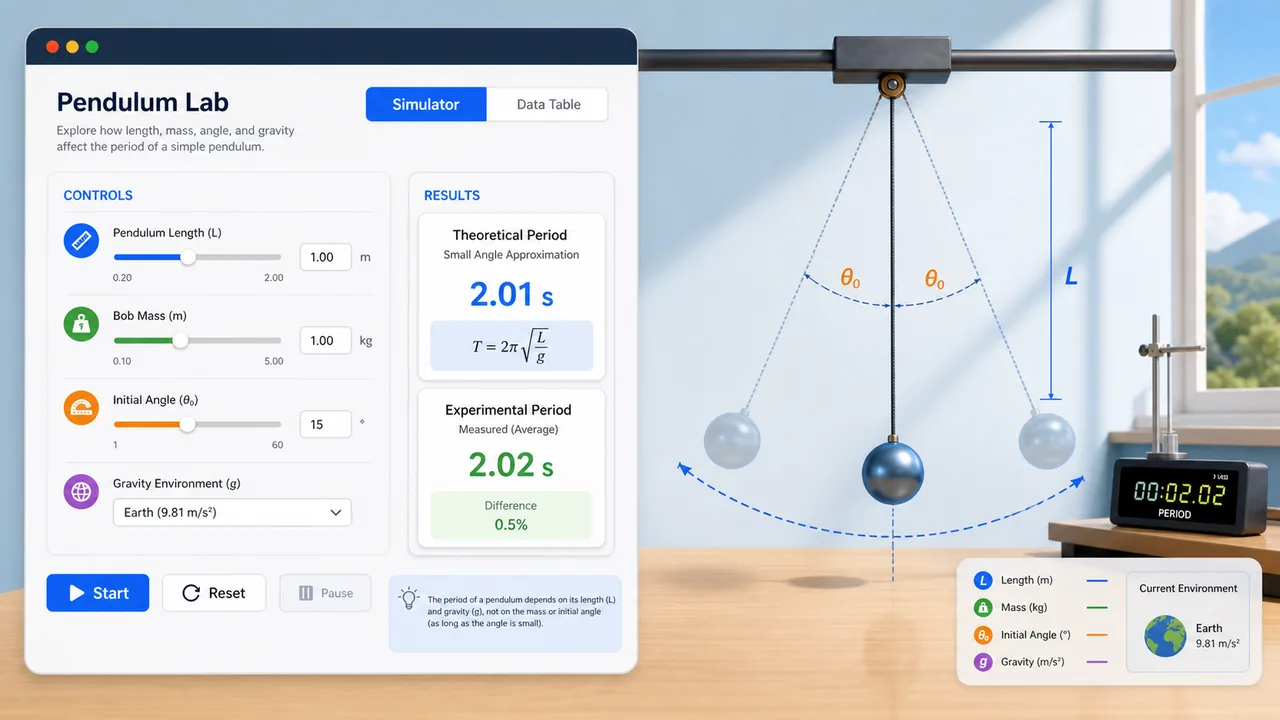
Pendulum Lab Simulator lets students adjust pendulum length, bob mass, initial angle, and gravity environment while the pendulum animation, angular displacement graph, theoretical period, experimental period, frequency, and maximum speed update in real time.

Built for simple pendulum homework, gravity comparison, period experiments, and lab report practice.

Pendulum Lab Simulator interactive experiment

Start Pendulum Lab Simulator here: set length, mass, initial angle, and gravity, then compare T = 2π√(L/g) with the animated experimental period and live angle graph.

Pendulum Lab Simulator controls

Change pendulum length, bob mass, starting angle, and gravity environment to test which inputs affect period.

Share Pendulum Lab Simulator

Share the clean page or copy a result link that restores this Pendulum Lab Simulator setup.

Virtual pendulum lab

Earth

Running
Small-angle model T = 2π√(L/g)
Current angle 20.0°
20°

Live Pendulum Lab Simulator result

What affects period?

Length affects
Gravity affects
Mass no effect

Angular displacement

Pendulum Lab Simulator angle graph

0.50 Hz
45° 0 -45° 0 8.0 s

Pendulum Lab Simulator period comparison

Theoretical period

2.01 s

Experimental period

2.02 s

Frequency

0.50 Hz

Maximum speed

1.09 m/s

Theory versus experiment

Pendulum Lab Simulator uses an ideal simple pendulum model. The theoretical period uses the small-angle formula, while the experimental period adds a small amplitude correction for larger angles.

Pendulum Lab Simulator experiment workflow

Pendulum Lab Simulator connects controls, animation, formulas, and graphing so learners can see why length and gravity change period while mass does not.

Pendulum Lab Simulator live controls

Adjust pendulum length, bob mass, initial angle, and gravity environment, then watch the swing and output cards update immediately.

Pendulum Lab Simulator interface with length, mass, angle, gravity controls, swing animation, theoretical period, and experimental period

Pendulum Lab Simulator theory comparison

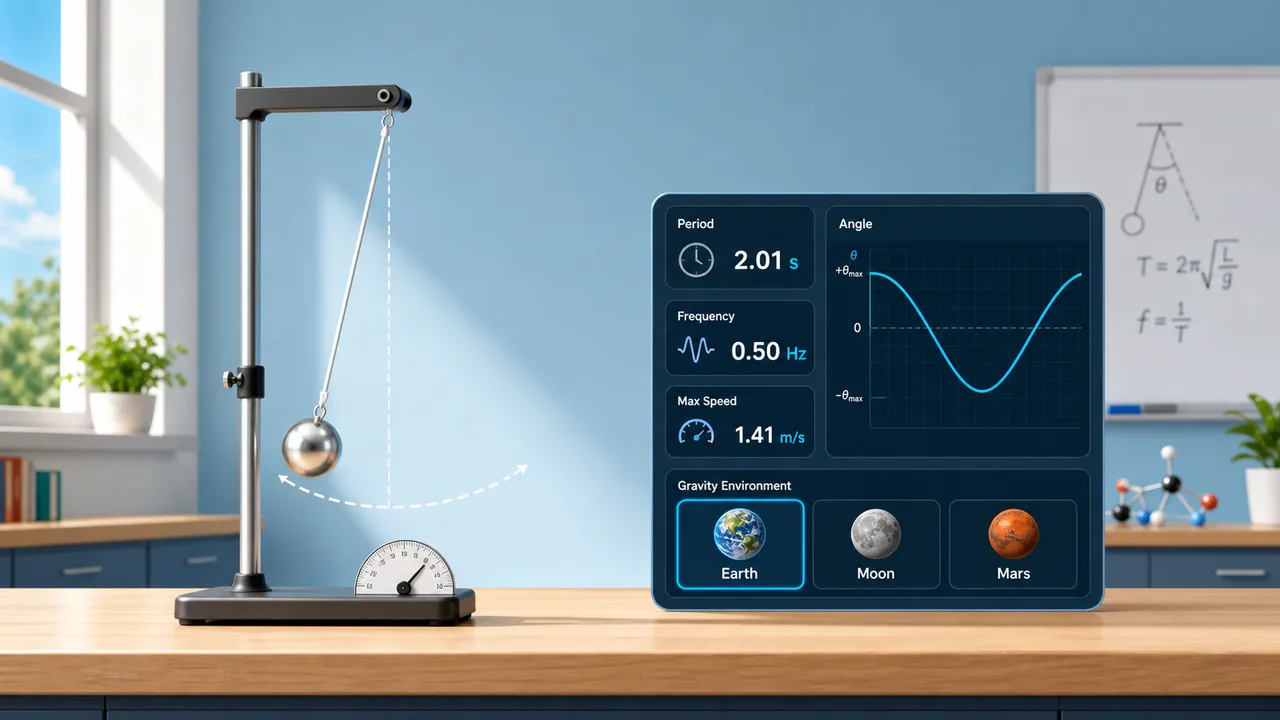
Compare Earth, Moon, Mars, and custom gravity results while Pendulum Lab Simulator plots angular displacement and explains which factors affect period.

Pendulum Lab Simulator comparison with Earth Moon Mars pendulums, period chart, length effect, and mass test

Pendulum Lab Simulator quick guide

Use this Pendulum Lab Simulator guide to connect simple pendulum variables, period formula, gravity, and lab conclusions.

01

Set up Pendulum Lab Simulator

Choose pendulum length, bob mass, starting angle, and a gravity environment. Start with Earth, 1 m, and 20° for a familiar classroom setup.

  • Use a small angle to match T = 2π√(L/g) closely
  • Switch to Moon or Mars to see gravity change the period
Open simulator
02

Test Pendulum Lab Simulator variables

Change one input at a time. Increase length to make the swing slower, change gravity to compare planets, and change mass to confirm it does not control period.

  • Keep length fixed during the mass test
  • Compare 0.5 m and 2 m to make the length effect obvious
See features
03

Interpret Pendulum Lab Simulator results

Use the theoretical and experimental period cards, frequency, maximum speed, and angular displacement graph to write a clear lab conclusion.

For lab reports, state that ideal pendulum period depends mainly on length and gravity, not bob mass.

Read FAQ

Pendulum Lab Simulator features

These Pendulum Lab Simulator features make a simple pendulum experiment visible, repeatable, and easy to explain.

Pendulum Lab Simulator length control

Move from short to long pendulums and see the period increase with the square root of length.

Change length

Pendulum Lab Simulator gravity environments

Switch between Earth, Moon, Mars, or custom gravity to compare how g changes the swing.

Choose gravity

Pendulum Lab Simulator animation

Watch the bob swing with an angle arc and live angular displacement readout.

Watch swing

Pendulum Lab Simulator period math

Compare the theoretical small-angle period with the experimental animation period.

Compare period

Pendulum Lab Simulator graph

Use the angle graph to connect displacement, frequency, and repeated oscillations.

Plot angle

Pendulum Lab Simulator sharing

Copy a result link that restores length, mass, angle, and gravity for classmates or reports.

Share result

Pendulum Lab Simulator study use cases

Pendulum Lab Simulator helps learners move from formula memorization to visible experiment evidence.

Pendulum Lab Simulator for students

Practice period, frequency, maximum speed, and displacement questions before quizzes.

Study
Practice now

Pendulum Lab Simulator for teachers

Demonstrate why length and gravity affect period while mass does not in the ideal model.

Classroom
Teach pendulum

Pendulum Lab Simulator for lab prep

Preview variable control, theoretical period, and experimental comparison before a real pendulum lab.

Lab prep
Prepare lab

Pendulum Lab Simulator for review

Compare Earth, Moon, Mars, and custom gravity without rebuilding the apparatus.

Review
Compare gravity

More tools after Pendulum Lab Simulator

After Pendulum Lab Simulator, try another free browser simulator for physics, science, school, math, or planning practice.

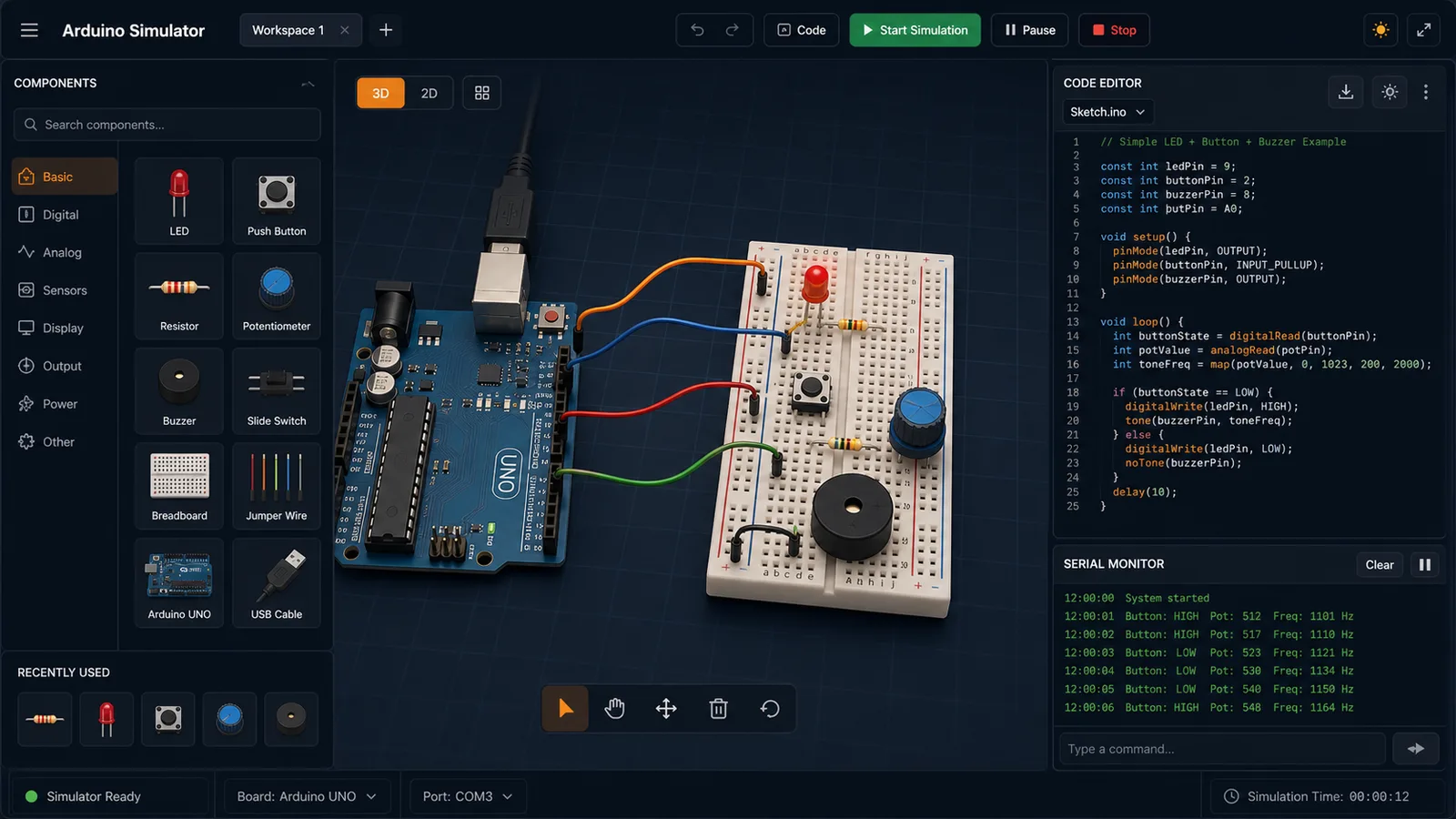
Arduino Simulator

Drag LED, resistor, button, potentiometer, and buzzer parts into a browser circuit and run beginner Arduino sketches.

Arduino Simulator preview showing the browser circuit workspace, code panel, and serial monitor
Open simulator

Gravity Simulator

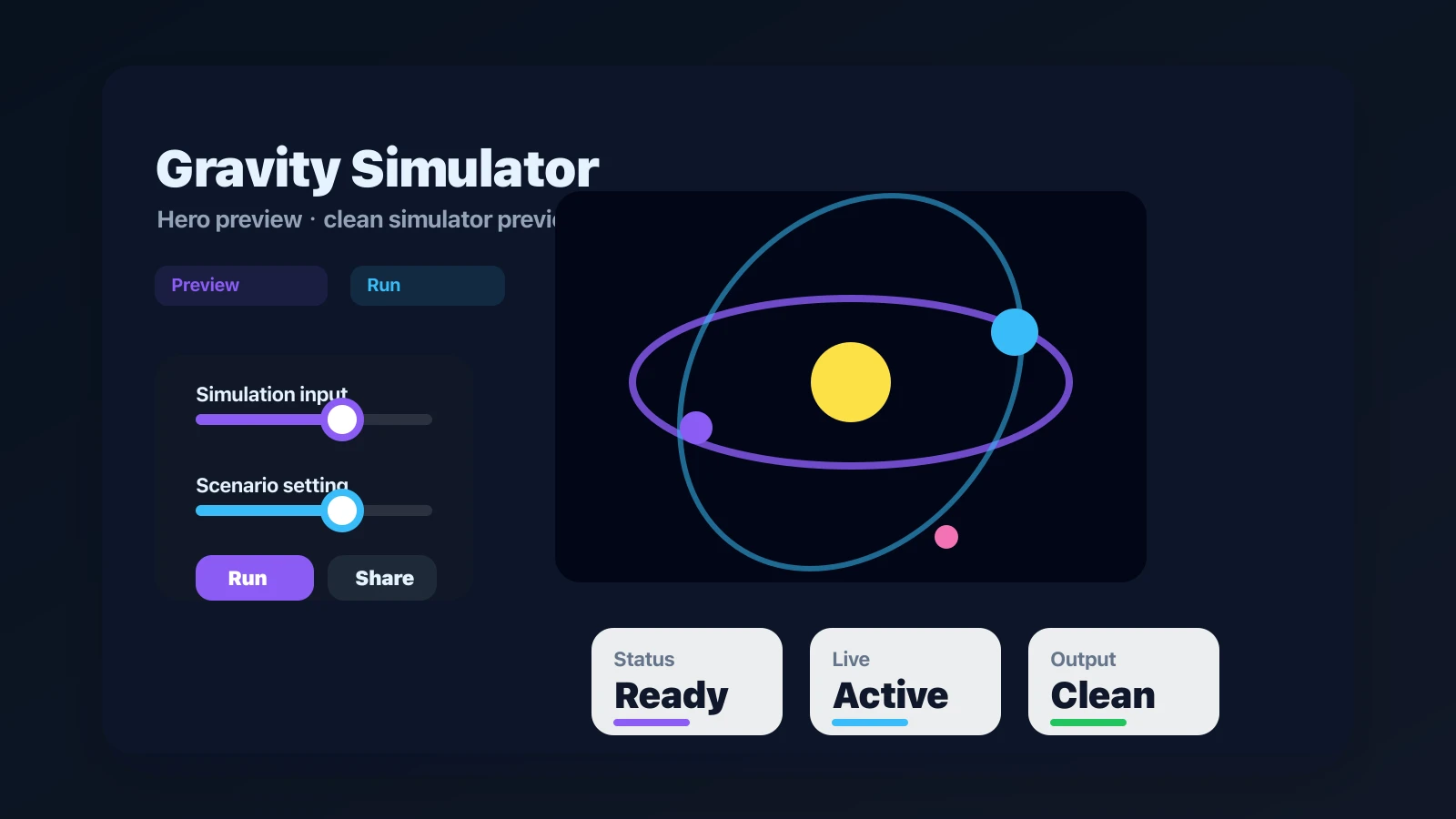
Drop planets, stars, and black holes into an N-body physics sandbox with shareable presets.

Gravity Simulator preview showing the browser simulator interface and result
Open simulator

Airfoil Simulator

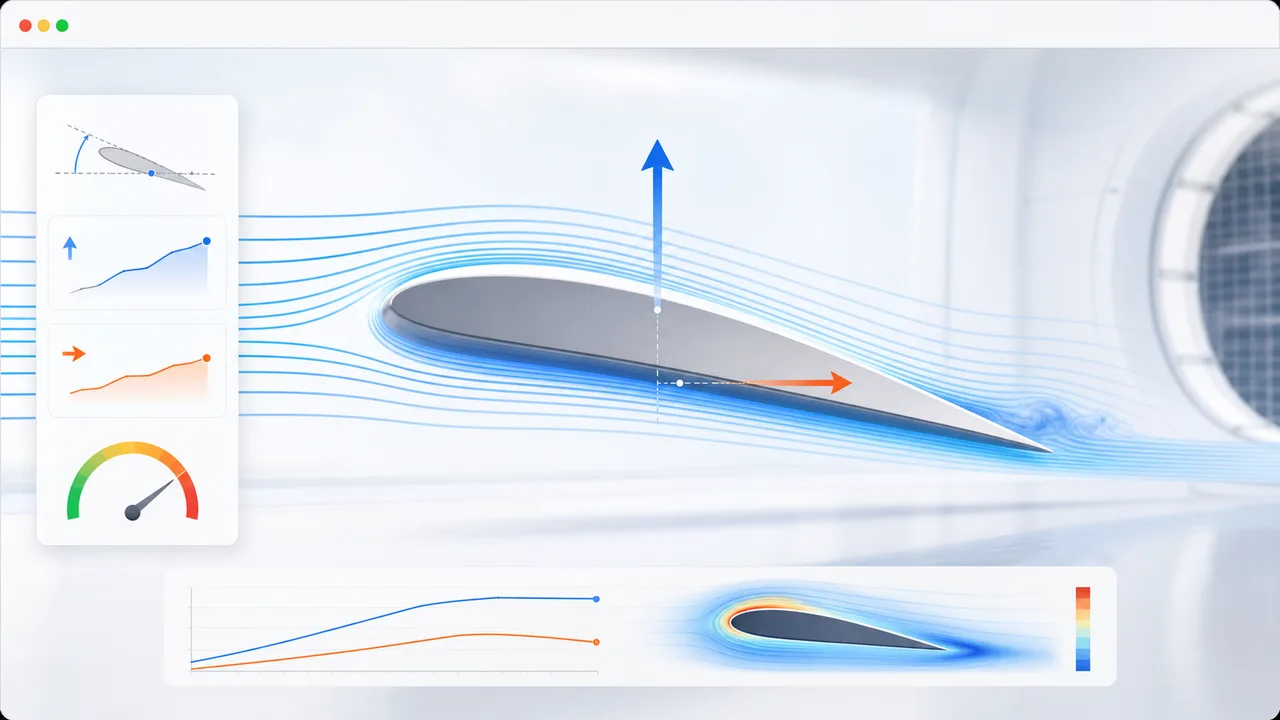
Set angle of attack, air speed, wing area, air density, and airfoil shape to estimate lift, drag, lift-to-drag ratio, and stall risk.

Airfoil Simulator preview showing airflow streamlines, airfoil controls, lift, drag, and stall risk
Open simulator

Earthquake Building Simulator

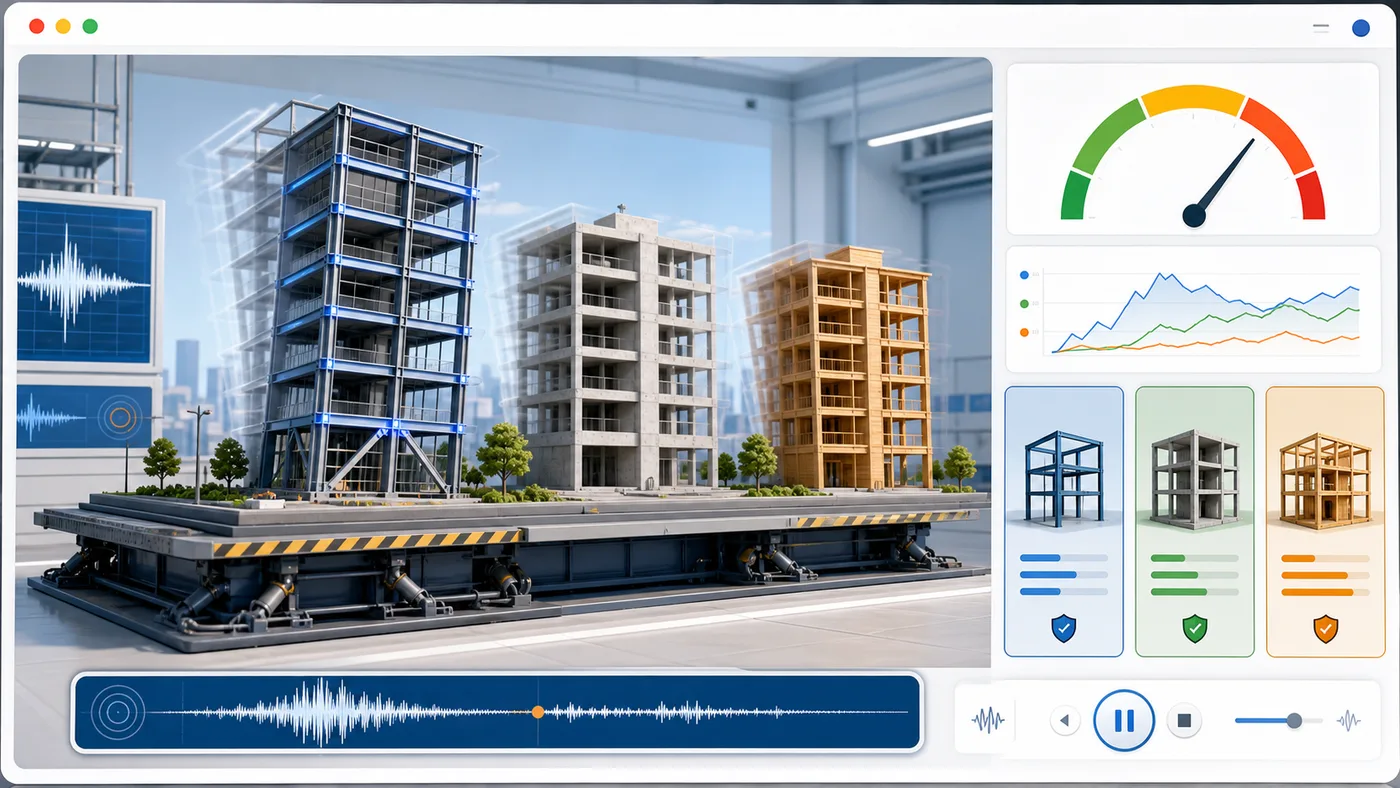
Enter building height, floors, material, structure type, earthquake magnitude, and foundation condition to animate sway and compare seismic risk.

Earthquake Building Simulator preview showing buildings swaying on a shake table with material comparison and risk score
Open simulator

Projectile Motion Simulator

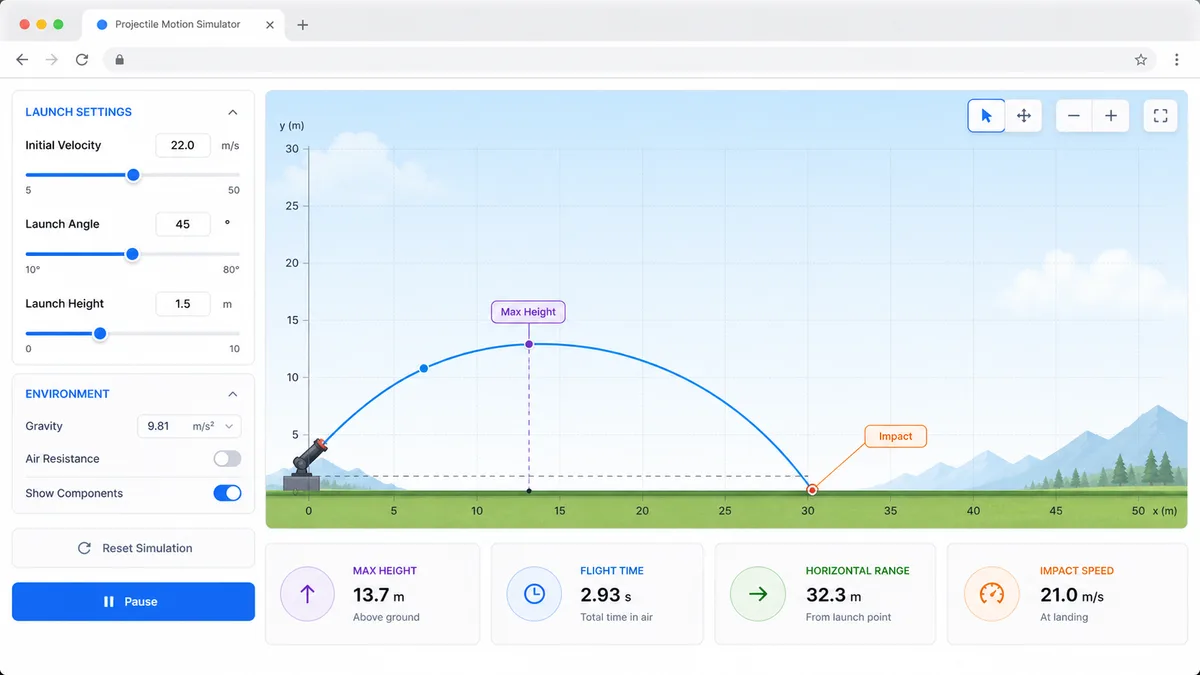
Set velocity, angle, height, gravity, and air resistance to compare projectile trajectories and live physics metrics.

Projectile Motion Simulator preview showing trajectory controls, curve animation, and result metrics
Open simulator

Stopping Distance Simulator

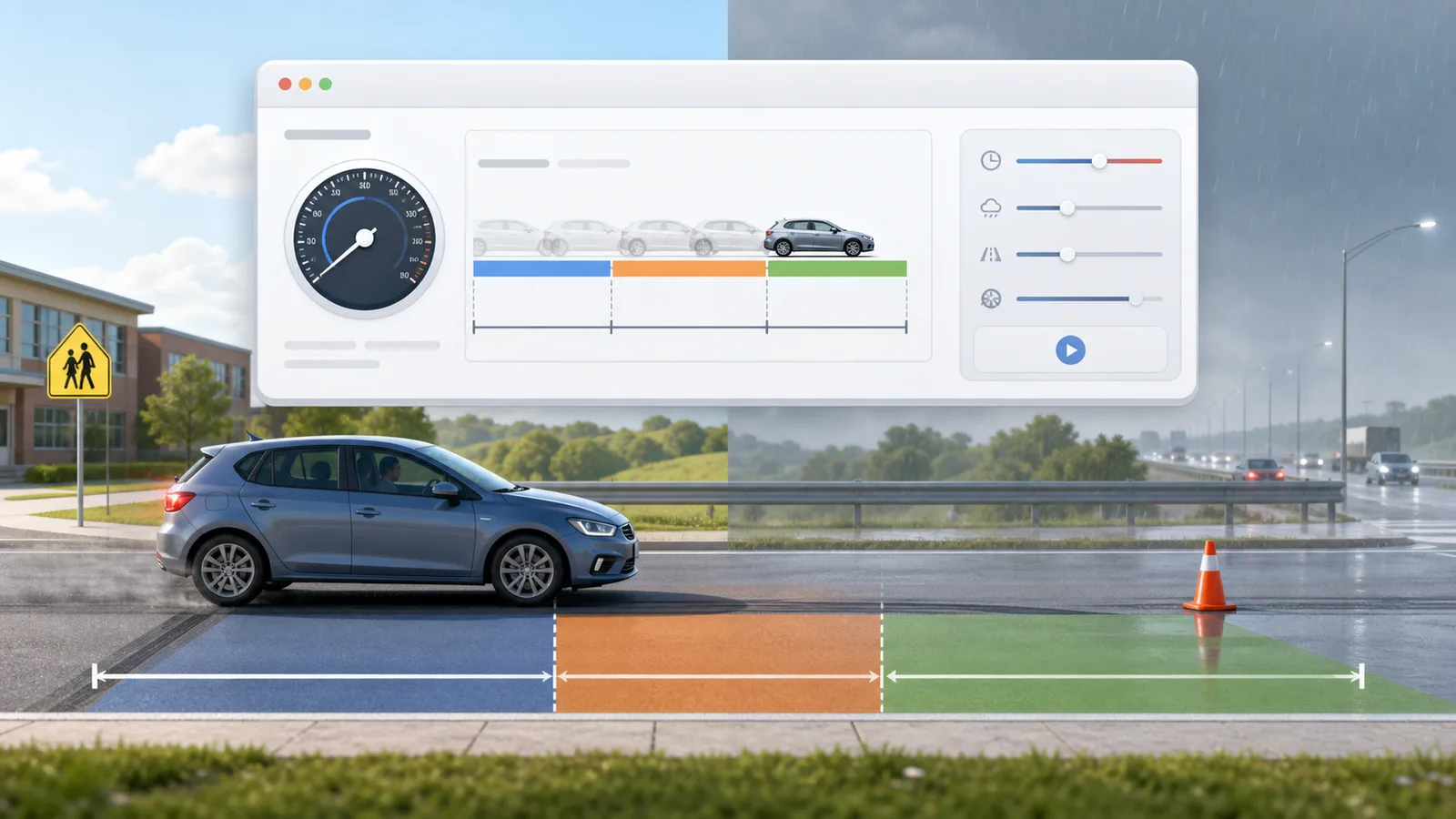
Enter speed, reaction time, weather, road surface, tires, and vehicle type to compare reaction, braking, and total stopping distance.

Stopping Distance Simulator preview showing braking distance controls, road scenarios, and result metrics
Open simulator

Solar Panel Simulator

Enter location, roof area, panel count, wattage, orientation, tilt, shading, and electricity rate to estimate solar output, savings, and payback.

Solar Panel Simulator preview showing rooftop panels, energy production, savings, and payback comparison
Open simulator

Solar Eclipse Simulator

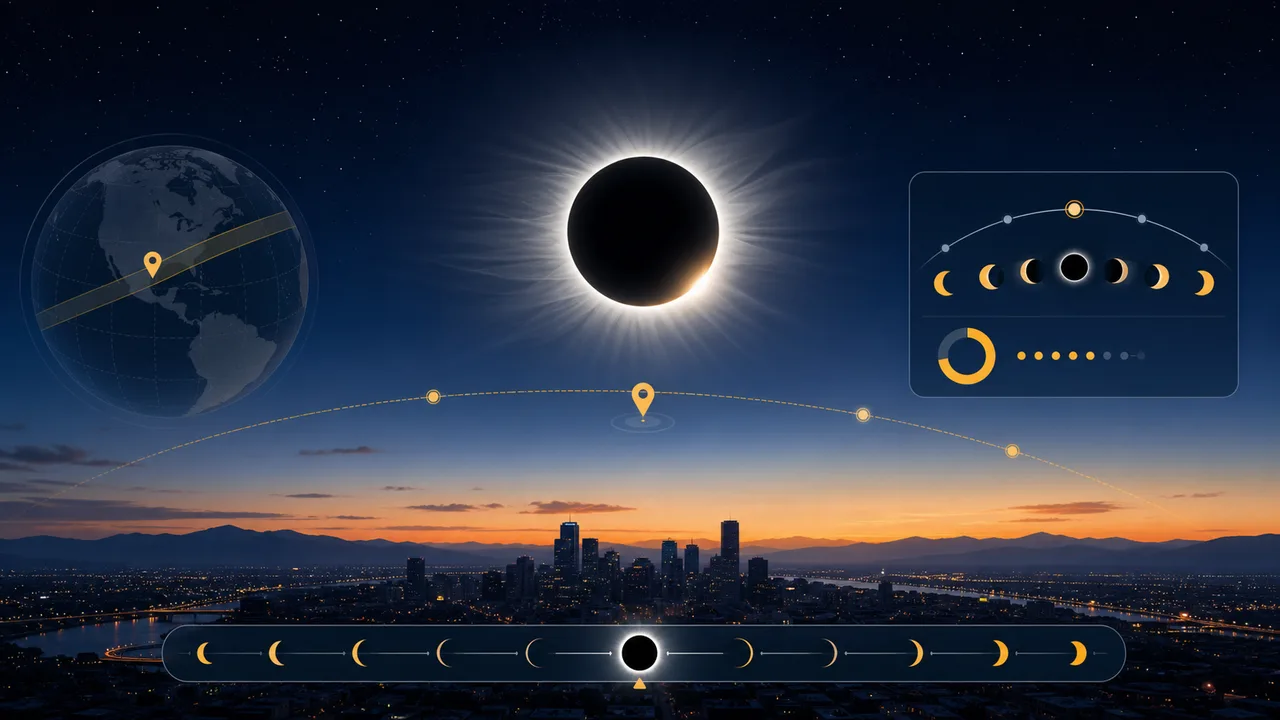
Enter a city or coordinates, choose an eclipse event, and estimate local visibility, timing, obscuration, and safety reminders.

Solar Eclipse Simulator preview showing an eclipse path, local visibility results, timeline, and safety reminders
Open simulator
View all simulators

Pendulum Lab Simulator FAQ

Fast answers about Pendulum Lab Simulator length, mass, gravity, angle, period, frequency, and the T = 2π√(L/g) formula.

Is Pendulum Lab Simulator free?

Yes. Pendulum Lab Simulator runs in the browser and can be used without an account or installation.

What formula does Pendulum Lab Simulator use?

Pendulum Lab Simulator uses the small-angle simple pendulum formula T = 2π√(L/g) for theoretical period, where L is pendulum length and g is gravitational acceleration.

Does mass change period in Pendulum Lab Simulator?

In the ideal Pendulum Lab Simulator model, changing bob mass does not change the period. Length and gravity control the period, while mass changes only the visual bob size.

Why does Pendulum Lab Simulator show an experimental period?

Pendulum Lab Simulator adds a small amplitude correction for larger initial angles, then compares that animated experimental period with the small-angle theoretical period.

Can Pendulum Lab Simulator compare Earth, Moon, and Mars?

Yes. Pendulum Lab Simulator includes Earth, Moon, Mars, and custom gravity so students can see that lower gravity produces a longer period for the same length.

Start Pendulum Lab Simulator now

Open Pendulum Lab Simulator, set the pendulum length, mass, angle, and gravity, then watch the swing and angle graph update instantly.

Compare theoretical and experimental period, test the mass effect, and explain which variables control simple pendulum period.

Pendulum Lab Simulator keeps shared results in an explicit copied URL only.