01
Enter Compound Interest Simulator money inputs
Choose currency, starting principal, contribution amount, annual return, and investment years.
- Use the same currency for every money input
- Keep the annual return as an estimate, not a promise
Free Compound Interest Simulator
Compound Interest Simulator models principal, periodic contributions, investment earnings, account value, target time, and comparison scenarios so long-term growth feels visible instead of abstract.
Built for quick Compound Interest Simulator checks across USD, CNY, EUR, GBP, CAD, AUD, and more.
Start Compound Interest Simulator here: choose currency, enter principal, contribution amount, annual return, years, compounding frequency, contribution frequency, and a target amount.
Adjust currency, starting principal, periodic contribution, annual return, years, compounding frequency, contribution frequency, and target. Compound Interest Simulator recalculates every result instantly.
Currency
The selected currency is used for principal, contributions, final value, earnings, and scenario comparisons.
Growth inputs
Use realistic estimates and change one input at a time to see which lever matters most.
Frequency and target
Choose how often interest compounds and how often new money is added.
Normal edits keep the clean page URL. Copy a result link only when you want to share the entered scenario.
Final account value
$0
Total principal invested
$0
Compound earnings
$0
Average annual growth
$0
Track cumulative principal, investment earnings, and total account value over time.
Review selected years to see how invested principal and compound earnings separate over time.
Compare monthly 100 vs monthly 300, and 10 years vs 30 years, using the same model.
Low, medium, and high return scenarios show how sensitive the final result is to the annual rate assumption.
Compound Interest Simulator is an educational planning tool. It uses simplified assumptions and does not provide investment, tax, or financial advice.
Compound Interest Simulator turns inputs into a timeline, target estimate, and scenario comparison that make nonlinear growth easier to inspect.
Compound Interest Simulator calculates principal, contribution totals, investment earnings, and total account value year by year.

Compound Interest Simulator compares higher contributions, longer timelines, and low, medium, or high return assumptions.

Use this Compound Interest Simulator guide to test steady contributions, earlier starts, return assumptions, and target timing.
Choose currency, starting principal, contribution amount, annual return, and investment years.
Set compounding frequency and contribution frequency, then add a target amount to estimate how long the path may take.
Use the scenario cards to compare monthly 100 vs 300, 10 vs 30 years, and low, medium, or high return assumptions.
The most useful lesson is the shape: later years can accelerate because previous earnings keep earning.
Explore more simulatorsCompound Interest Simulator focuses on the choices that most change long-term results: money added, time invested, and return assumptions.
Display principal, contribution, final value, and earnings in USD, CNY, EUR, GBP, CAD, AUD, and more.
See yearly principal, investment earnings, and total account value in one growth chart.
Estimate how long it may take to reach a target amount with the current contribution and return assumptions.
Compare higher contributions, longer timelines, and different annual return assumptions without rebuilding inputs.
Copy a clean summary, export yearly CSV data, or create a result link only when you choose to share.
Make the nonlinear effect visible: stable contributions and time can make later growth much larger.
Compound Interest Simulator helps compare simple long-term saving and investing assumptions before turning them into a real plan.
Compare monthly contribution amounts and see how the gap widens over many years.
Test a 10-year path against a 30-year path to show why starting earlier matters.
Compare low, medium, and high annual return assumptions without treating any estimate as guaranteed.
Estimate the time needed to reach a target balance under the current inputs.
After Compound Interest Simulator, try related tools for budgets, loans, home costs, and broader financial planning.
Enter income, rent, food, transportation, entertainment, shopping, subscriptions, insurance, debt repayment, and savings goals to see remaining cash and budget pressure.

Enter a restaurant bill, tip percentage, tax rate, party size, and split mode to calculate the tip, total, per-person amount, and tip comparisons.

Enter distance, fuel economy, fuel price, weekly trips, and vehicle type to estimate trip, weekly, monthly, yearly, and vehicle comparison fuel costs.

Compare driving, public transit, biking, walking, and taxi commutes by monthly cost, yearly cost, time, and balanced recommendations.

Enter supermarket area, customer traffic, basket value, costs, wages, rent, utilities, shrinkage, discount, staffing, and shelf capacity to estimate profit, margin, inventory risk, satisfaction, and cash flow.

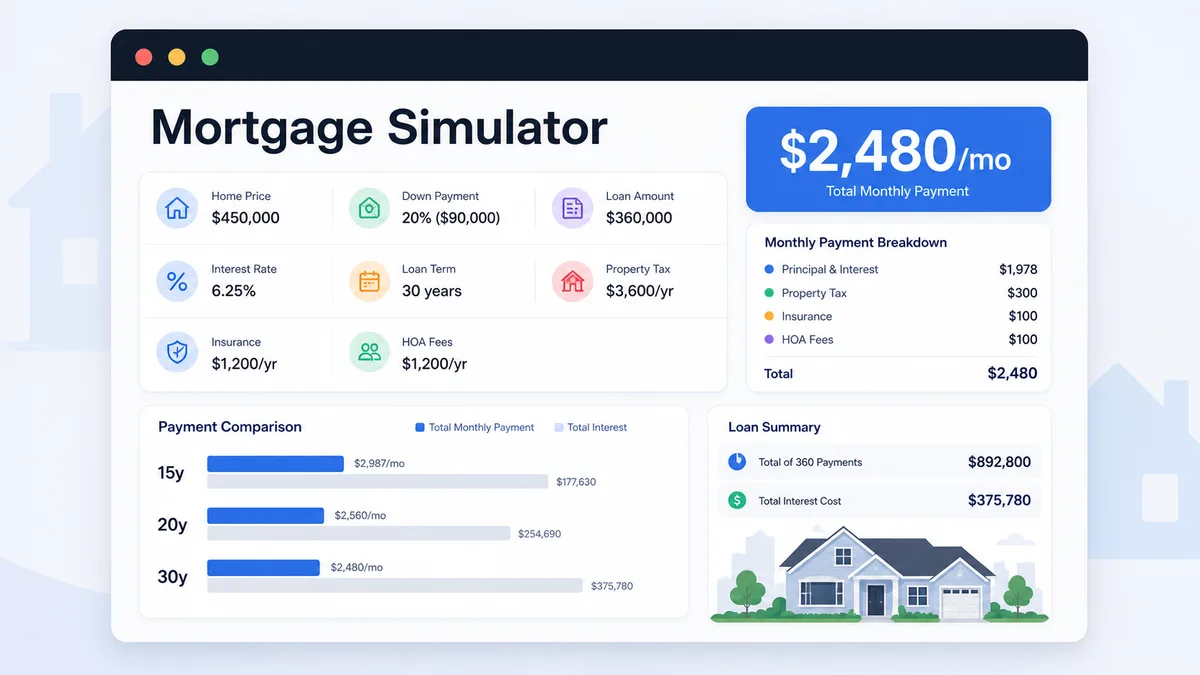
Enter home price, down payment, loan amount, rate, term, taxes, insurance, and HOA to compare monthly payment and total interest.
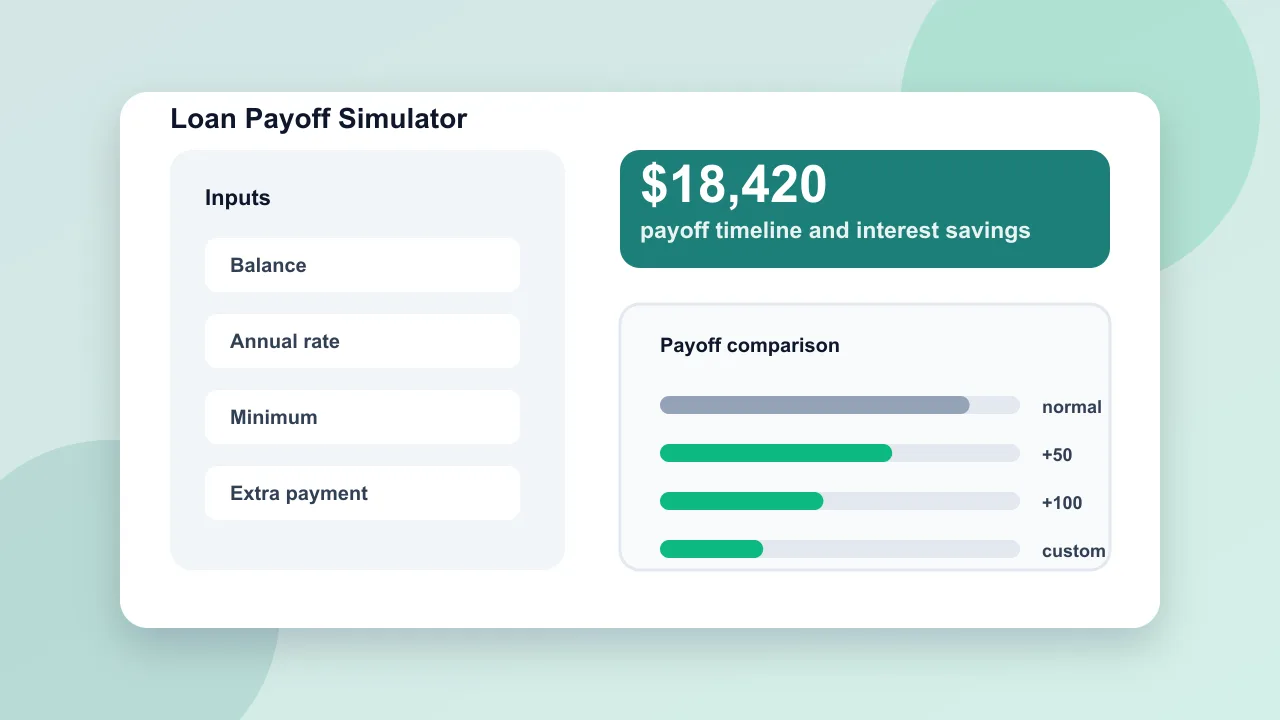
Enter loan balance, annual rate, minimum payment, planned payment, and extra repayment to compare payoff time and interest savings.
Estimate home renovation costs by room, finish level, project toggles, cost breakdown, contingency, DIY options, and budget report.

Common questions about how Compound Interest Simulator models growth, contributions, and targets.
Compound Interest Simulator applies the selected annual return at the chosen compounding frequency, adds contributions at the chosen contribution frequency, and records yearly principal, earnings, and total value.
No. Compound Interest Simulator is an educational estimator. Real investment returns vary and may include fees, taxes, losses, inflation, and timing risk.
Later years include earnings on the original principal, new contributions, and previous earnings. That is why the total value curve is not linear.
Yes. Compound Interest Simulator includes a contribution comparison that estimates the result difference between monthly 100 and monthly 300 over the same time period.
Yes. Normal edits keep the clean URL, and the copy result link button creates a parameterized URL only when you explicitly choose to share a scenario.
Open Compound Interest Simulator, change one assumption, and watch the long-term curve update instantly.
Use the result to understand the mechanics of time, steady contributions, and compounding before making real financial decisions.
Free, browser-based, and designed for learning rather than financial advice.